How to plan an efficient house tour route in Vancouver
Buying a home in Greater Vancouver is already one of the most demanding real estate processes in Canada. Add a sprawling geography, dozens of competing sub-markets, and a group text full of realtor.ca links from your partner, parents, and agent, and what should be an exciting weekend turns into a logistics headache. The good news is that most of the friction is avoidable if you approach the tour like a routing problem before you set foot in a single house.
 Westin Tanley
May 29, 2026 · 6 min read
Westin Tanley
May 29, 2026 · 6 min read
What makes house touring in Vancouver so difficult
Three problems derail most Vancouver house tours before the first showing even happens. The first is volume: listings arrive from multiple people across multiple channels, and the shortlist never quite exists as a single document. The second is geography: the Fraser River and the region's bridges mean that a route built by preference rather than location will cost you an hour of driving you did not budget for. The third is memory: after five or six showings in a day, the details blur fast and there is nothing to refer back to. Each problem is solvable on its own. The frustrating part is that most buyers are trying to solve all three at once, on the fly, on tour day.
Challenge 1: The listing flood — too many properties, too many links
Greater Vancouver spans more than a dozen municipalities, and a buyer open to townhouses anywhere in the Lower Mainland can easily face 200 to 400 active listings at once. One partner sends a link from Burnaby, the other sends three from Coquitlam, the agent sends five more, and a parent weighs in with something from South Surrey. By the end of the week the group chat has forty URLs, several of them duplicates, and nobody can agree on what the actual shortlist is or which ones still have open houses scheduled.
Challenge 2: Vancouver's geography adds a routing problem
The Fraser River, Burrard Inlet, and mountain ranges mean that two houses appearing close on a list can be 90 minutes apart in traffic. The Port Mann, Alex Fraser, and Pattullo bridges are chokepoints on open house weekends. Buyers who do not group stops by geography consistently run late, miss showings, and spend the day driving past better options ten minutes away that never made the schedule because nobody thought to cluster them.
Challenge 3: Keeping track of what you actually saw
After a day of five or six showings, impressions blur fast. By Sunday evening most buyers cannot remember whether it was the Coquitlam townhouse or the New Westminster one with the awkward layout. Over a multi-week search this compounds: buyers re-read the same listing pages to recall details they already reviewed twice, and every comparison requires opening two browser tabs because there is no organized record of what they have already seen and ruled out.
How buyers have traditionally handled this
The most common approach is a shared spreadsheet. One person builds a tab with columns for address, price, property type, open house time, and notes. Everyone fills it in manually by reading through each listing. It works better than a WhatsApp thread, but it requires someone to maintain it, and copying details by hand from realtor.ca is tedious enough that it usually only covers the top five or six properties, not the full twenty-property longlist that most serious buyers accumulate.
Some buyers use Google Maps to plan the route. They drop pins for each property and use the directions tool to get a driving order. This solves the geography problem in isolation but tells you nothing about open house windows, so you still have to cross-reference your spreadsheet manually to confirm that a particular house is actually accessible during the hours you plan to be in the area.
Others rely on their agent to handle the logistics entirely. A good buyer's agent can absolutely build a showing schedule, but the coordination of which links the buyers have sent, which properties the family has voted on, and which ones have open house windows that week is more communication overhead than it needs to be for any party involved.
How Tour 21 changes the process
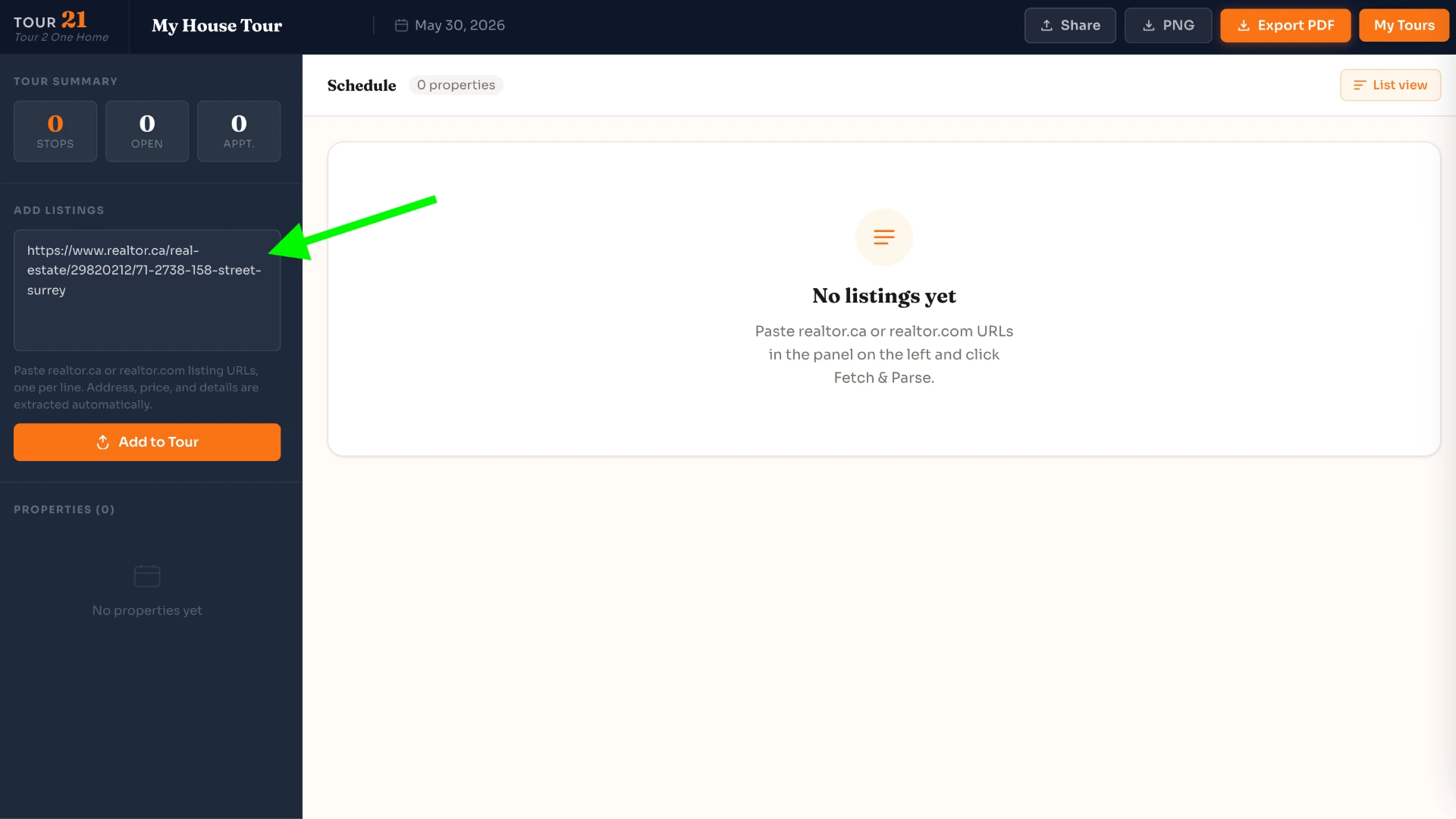
Tour 21 was built to handle all three of these problems in a single workflow. You paste a realtor.ca URL and it pulls the listing details automatically: the address, the price, the property type, and the open house windows. There is no manual copying. If your partner finds a listing and sends you the link, you paste it in. If your agent sends five links in one message, you paste all five. The tour becomes the single source of truth for everyone working on the search together.
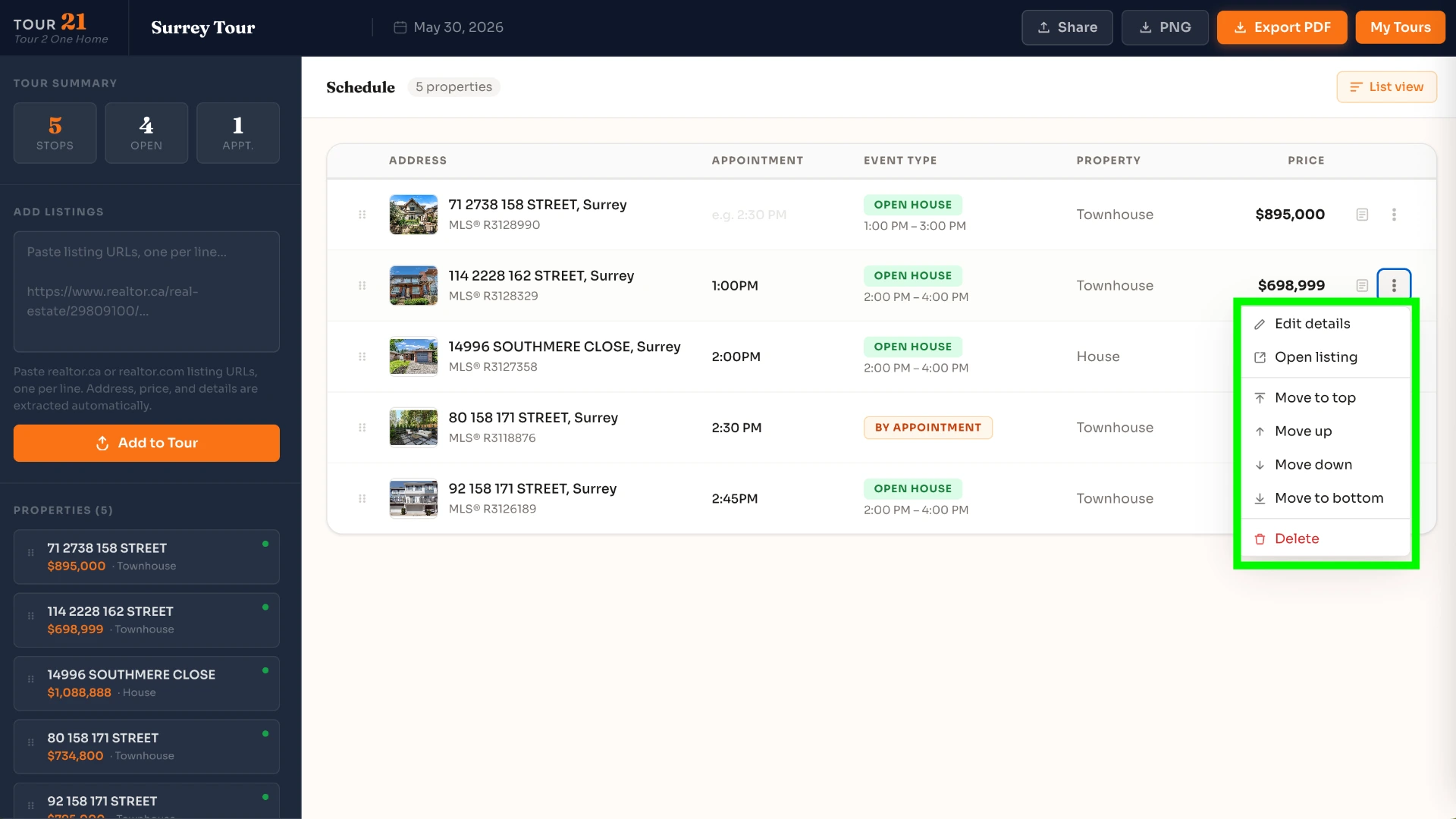
Once your listings are in the tour, you arrange them in visit order. The tour is drag-and-drop, so you cluster properties by geography before tour day. All of your Burnaby and New Westminster stops go first, then the Coquitlam and Port Moody ones, rather than alternating back and forth across the river. You set approximate visit times for each property and immediately see whether your schedule leaves enough time between stops given the open house windows.
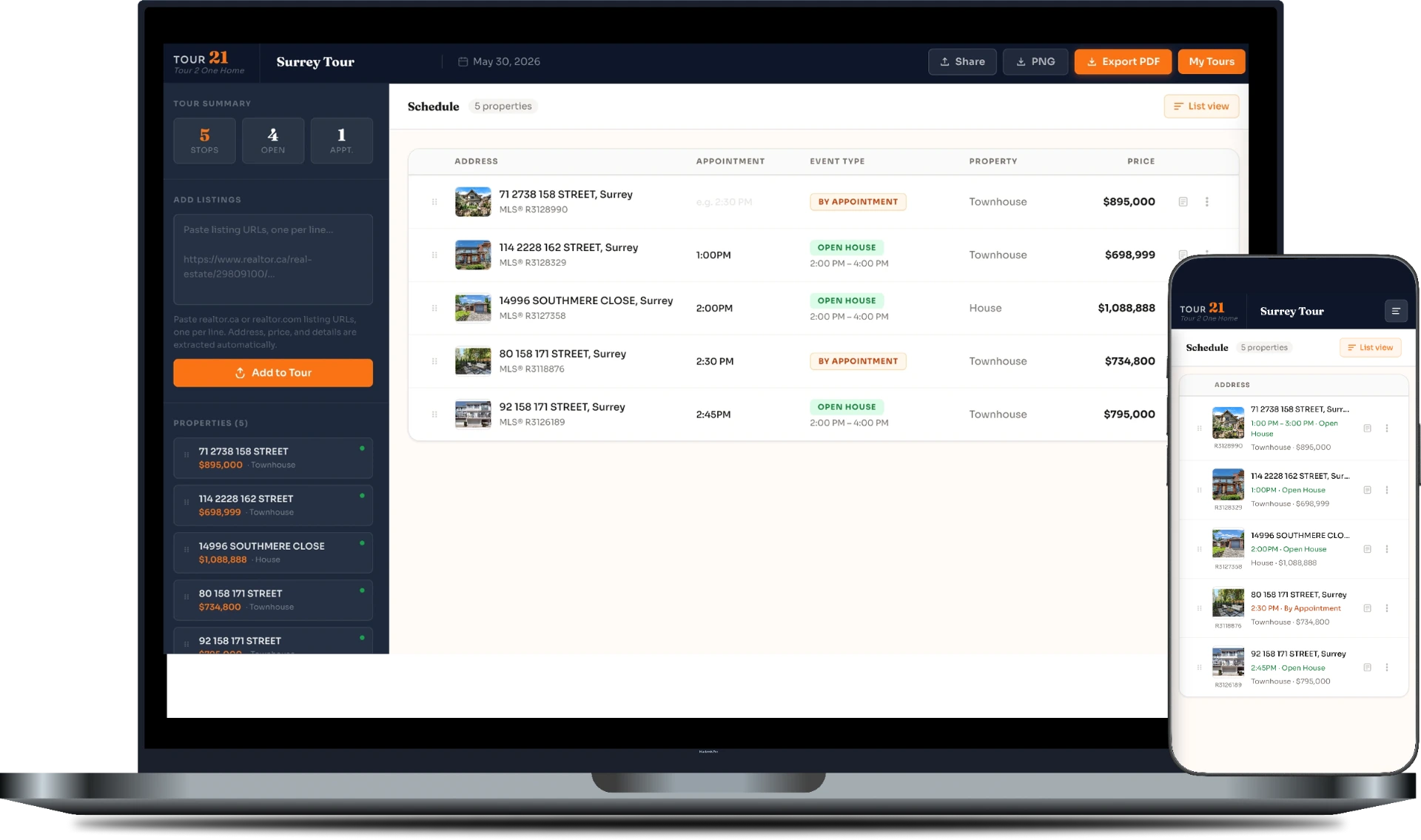
When the schedule is ready, you share one link. Your partner has it, your parents have it, your agent has it. Everyone is working from the same ordered list with the same details. On tour day you follow that single document instead of scrolling through a message thread trying to remember which URL was which. After the tour, the list stays available as a record of what you saw, what the prices were, and what you noted about each property.
Frequently asked questions
How many houses can you realistically tour in one day in Vancouver?
Five to eight properties is a comfortable pace. Beyond eight, the showings start to blur together and you stop evaluating them clearly. If you have more than eight on your shortlist, split them across two days by geography.
What is the best way to organize realtor.ca listings for a tour?
Paste each URL into a tour planner that pulls the listing details automatically. Trying to copy addresses and open house times by hand from realtor.ca into a spreadsheet is slow and error-prone.
How do you avoid bridge delays when touring houses in Greater Vancouver?
Plan your tour so all stops in a single day sit on the same side of the Fraser River. Burnaby, New Westminster, Coquitlam, and Port Moody form a natural cluster. Surrey, Langley, and Delta form another. Mixing them means at least one bridge crossing per day, often during peak hours.
How do you share a house tour schedule with your real estate agent?
A shared link is far more useful than a forwarded WhatsApp thread. Tour 21 lets you export your scheduled tour as a printable PDF or share the live link directly with your agent so everyone sees the same ordered list.
What should you do if two open houses overlap in time?
Pick the one with the shorter open house window first, then go to the other. Most open houses run two hours. If the windows overlap by less than 30 minutes and the properties are close, you can usually make both. Tour 21 shows open house times next to each listing so you can spot conflicts before tour day.
Conclusion
House hunting in Greater Vancouver is a logistics problem as much as it is a real estate decision. The listing volume, the geography, and the coordination across family members and agents all create friction that compounds over a multi-week search. Getting organized before tour day, grouping properties by area rather than by preference order alone, and keeping one shared document that everyone can reference is what separates a productive Saturday from a frustrating one. Start your first tour on Tour 21 and see how much simpler the day looks when the route is planned before you leave the house.